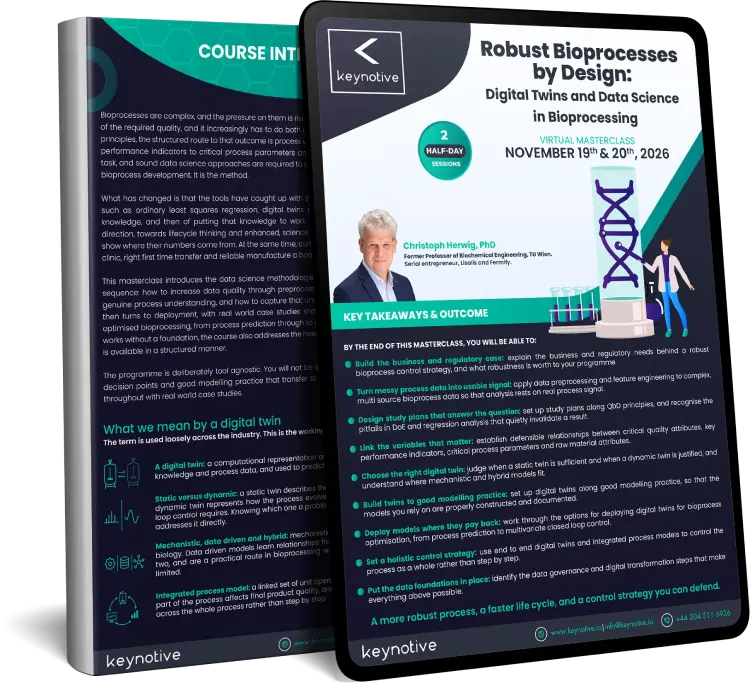


Bioprocesses are complex, and the pressure on them is rising. A process has to be robust, it has to deliver product of the required quality, and it increasingly has to do both at pace and at lower cost. Following Quality by Design principles, the structured route to that outcome is process understanding: linking critical quality attributes and key performance indicators to critical process parameters and raw material attributes. That is a multidimensional task, and sound data science approaches are required to address it. Data science is no longer a nice addition to bioprocess development. It is the method.
What has changed is that the tools have caught up with the ambition. Alongside classical multivariate models such as ordinary least squares regression, digital twins now offer a powerful means of capturing process knowledge, and then of putting that knowledge to work. Regulatory expectations have moved in the same direction, towards lifecycle thinking and enhanced, science based development, which rewards teams that can show where their numbers come from. At the same time, commercial pressure on biopharma has made speed to clinic, right first time transfer and reliable manufacture a board level concern rather than a technical one.
This masterclass introduces the data science methodologies that make this practical. It covers three things in sequence: how to increase data quality through preprocessing, how to regress complex data sets to achieve genuine process understanding, and how to capture that understanding in mechanistic or hybrid digital twins. It then turns to deployment, with real world case studies showing how those twins help deploy knowledge for optimised bioprocessing, from process prediction through to multivariate closed loop control. Because none of it works without a foundation, the course also addresses the need for proper data governance, so that process data is available in a structured manner.
The programme is deliberately tool agnostic. You will not be sold a software platform. The focus is on methods, decision points and good modelling practice that transfer to whatever stack your organisation runs, illustrated throughout with real world case studies.
.webp)
BY THE END OF THIS MASTERCLASS, YOU WILL BE ABLE TO:

Learn from someone who helped build the field: fifteen years as full professor of biochemical engineering at TU Wien, and founder of a company that pioneered data science software for the biopharma life cycle. The course is taught method first and stays tool agnostic.
Close the gap between data science and bioprocessing: most teams have people strong in one and people strong in the other. This course gives both groups a shared vocabulary and a shared method.
Avoid the modelling mistakes that cost months: pitfalls in DoE and regression analysis are common, expensive and easy to miss. They are covered directly rather than assumed away.
See digital twins actually deployed: the programme devotes a full module to in depth case studies of digital twins in use, not to theory alone.
Decide between static and dynamic twins: understanding which level of model a problem justifies is one of the most consequential early choices in any modelling project, and the course sets out how to make it.
Build a control strategy that holds together: end to end digital twins and integrated process models support a holistic control strategy rather than a collection of unit operation limits.


.png)


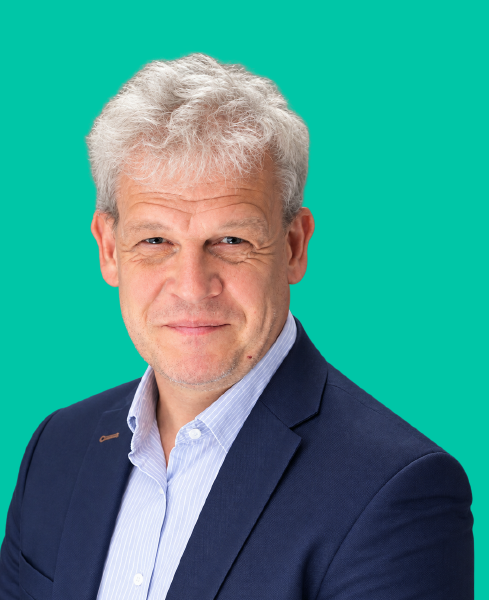
Christoph Herwig trained as a bioprocess engineer at RWTH Aachen and holds a PhD in bioprocess identification from EPFL in Switzerland. From 2008 to 2023 he was full professor of biochemical engineering at TU Wien, where his research focused on developing data science methods for integrated and efficient bioprocess development along PAT and QbD principles for biopharmaceuticals.
His industrial career, including time with Lonza, involved deep engagement in the design and commissioning of large chemical and biopharmaceutical facilities. In 2013 he founded Exputec, which pioneered data science software solutions for the biopharma life cycle and is now part of Körber Pharma. He was subsequently senior scientific advisor to Körber, a role concluding in September 2026. Since 2021 he has worked as a serial entrepreneur, supporting several start up companies operationally and providing the link between digital twins, digitalisation and bioprocess intensification.