

Bioprocesses are complex. Many influencing factors have to be identified before a process is robust, optimised and delivering the product quality you need. On top of that complexity sits a commercial reality that has sharpened considerably. Like the chemical and classical pharmaceutical industries before it, the biotech sector is under severe cost pressure. Biopharmaceuticals compete against biosimilars. Start-ups in the novel food field have to compete with conventional production systems that have been optimised for a very long time, the cow among them. In both cases the arithmetic points the same way. There is a strong need to intensify bioprocesses.
The industry has been moving in that direction. Perfusion and intensified upstream operations are being adopted more widely, cell retention hardware has matured, and the regulatory position has settled: ICH Q13 on continuous manufacturing reached Step 4 in late 2022, with final regional guidance following in 2023, which removed a good deal of the uncertainty that once made continuous a difficult internal sell. What has not settled is the decision itself. Continuous processing is not automatically the right answer for every product, every scale or every organisation, and the cost of finding that out after committing to a facility is high.
This masterclass introduces the methodologies for optimising bioprocesses, and it approaches them from two directions. On one side sit process science strategies: shortening the period of individual unit operations, optimising overall batch cycle time, and increasing the catalyst through cell retention techniques. On the other sit data science methods, including holistic optimisation and closed loop control. These methods apply to any process mode. Particular focus is then set on intensification through continuous processing, reviewing the challenges and showing the process configurations and methods that establish continuous processes robustly.
The programme is taught method first. The emphasis is on the decision points, the comparisons and the evidence needed to justify a direction, and the methods apply whatever equipment or software you happen to run. No product is promoted, and the course is structured to help you reach your own conclusion rather than to arrive at a predetermined one.
.webp)
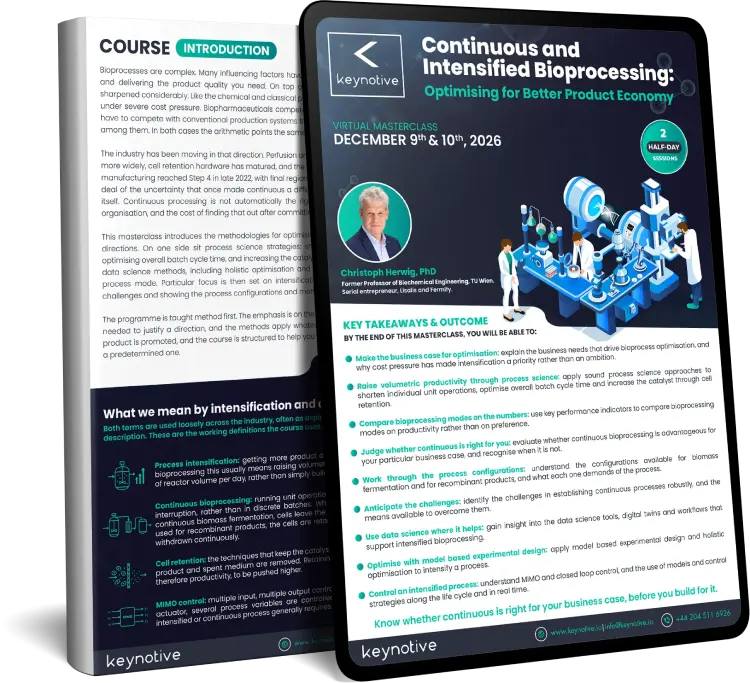
BY THE END OF THIS MASTERCLASS, YOU WILL BE ABLE TO:

Get an answer to the question that decides the investment: whether continuous processing is advantageous for your particular business case is a course objective, not an aside. You leave able to make that evaluation rather than repeat someone else’s conclusion.
Both halves of the problem, taught together: process science and data science are usually taught by different people in different rooms. Here they are taught by one person who works across both.
Compare modes on productivity: the course puts bioprocessing modes side by side against key performance indicators, so the comparison rests on numbers rather than on assumption.
Configurations for two different product types: process configurations are covered for biomass fermentation and for recombinant products, so the course speaks to industrial biotechnology and novel food as well as to biopharma.
The challenges are addressed directly: a full agenda item is given to the challenges of continuous processing and the means to overcome them, rather than to the benefits alone.
Understand what makes intensification controllable: digitalisation and control are treated as the enabler for continuous bioprocessing, which is the part most often underestimated in a business case.


.png)


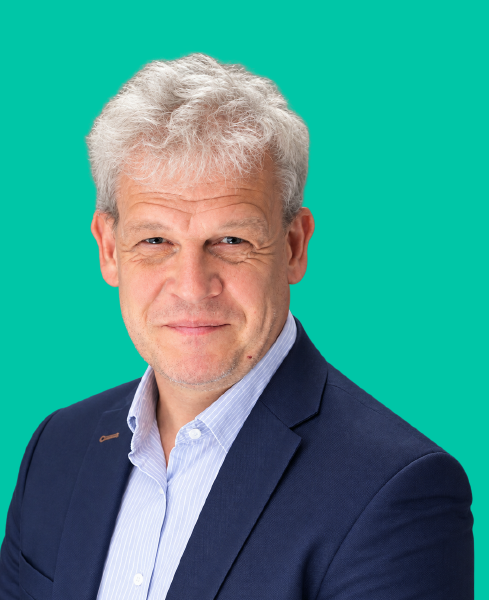
Christoph Herwig trained as a bioprocess engineer at RWTH Aachen and holds a PhD in bioprocess identification from EPFL in Switzerland. From 2008 to 2023 he was full professor of biochemical engineering at TU Wien, where his research focused on developing data science methods for integrated and efficient bioprocess development along PAT and QbD principles for biopharmaceuticals.
His industrial career, including time with Lonza, involved deep engagement in the design and commissioning of large chemical and biopharmaceutical facilities. In 2013 he founded Exputec, which pioneered data science software solutions for the biopharma life cycle and is now part of Körber Pharma. He was subsequently senior scientific advisor to Körber, a role concluding in September 2026. Since 2021 he has worked as a serial entrepreneur, supporting several start up companies operationally and providing the link between digital twins, digitalisation and bioprocess intensification.